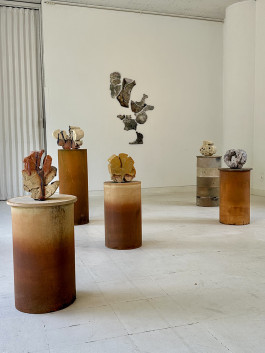
Floating Echoes
漂うこだま
Floating Echoes 漂うこだま
Shigaraki Ceramics Cultural Park, Japan. 2026.
“When, in earlier times, people faced the unexplainable – a sudden downpour from a clear sky, a wind strong enough to shake a mountain, the echo returning from an empty valley – yokai were imagined. Not only ghosts and spirits, but natural phenomena themselves, yokai gave name to what couldn’t be explained, symbols for invisible forces. This body of work, developed across two residencies in Japan, takes that idea of naming the unnameable as a starting point, finding it running through everything from material process to inherited memory.
Central to this is the oni – a shapeshifting figure in Japanese folklore, able to pass as human before revealing something else beneath, never settling into a single fixed form. That idea of otherness, of slipping between forms rather than resolving into one, resonated with a lived experience of being between cultures – not quite belonging fully to either. It emerges in the colour and surface of the work, drawing on the palettes of historical yokai artists: passages of clashing tone, or darker, more vibrant colour emerging from beneath the surface, echoing the oni's masking and passing between forms.
In a deliberate shift away from angular, precise work of recent years, this work developed at Commons/Oppes in the Bōsō Peninsula, Chiba, and continued at Shigaraki Ceramics Cultural Park, draws on this yokai research as well as the landscape, with textures holding the trace of the hand and body, textures of tree bark and torn clay.
The sense of moving between the familiar and the unknown, the distances and intimacies of mixed heritages, further echoes in sculptural works developed from kanji characters and matoi – the evocative sculptural banners once carried by Edo-period firefighting brigades, their shape somewhere between calligraphic character and angular yokai. Traced from their sources and rebuilt in clay, these characters are folded, stretched and reshaped until their outlines drift from legibility— the same object read as language by one viewer, and as shape alone by another.
Floating Echoes takes its title from this same condition, running through hand, form and folklore alike: something so familiar it becomes invisible in its usual shape, and yet, encountered afresh, is unmistakably present — like kodama, the echo-spirit said to live behind a mountain's answering call. It is a space between full fluency and other ways of seeing; between a knowledge held so closely it can no longer be seen clearly, and the outside eye that meets the same thing anew.”


